Critical Comms Asia — Issue #1 | June 2026
Where China Meets Global Critical Communications
Share ↓
01 • opening note
The Signals Were AlwaysThere
Every major disaster of the past decade has taught the same lesson.
When infrastructure fails, communications fails first. And when communications fails, everything else follows — the coordination breaks down, the response slows, the decisions get made on incomplete information at the worst possible moment. It does not matter whether it is a flood, an earthquake, a wildfire, or a grid failure. The pattern holds.
The critical communications industry exists because of that lesson. LMR systems were built to be resilient when commercial networks went down. PMR networks were built to give utilities and transport operators communications they could depend on when it mattered most. And now, MCX over LTE and 5G is being built to carry all of that forward into a world where voice alone is no longer enough — where the first responder in the field needs video, data, precise location, and real-time situational awareness, not just a channel to talk on.
The technology is ready. The transition is underway. What is changing, rapidly, is who is driving it.
In March 2026, China published its 15th Five-Year Plan. Then, on May 30th — just days before this issue went to press — the State Council issued its implementing document: the 15th Five-Year Plan for Modernising China’s Emergency Management System, State Council Document No. 15 of 2026. It is worth reading carefully.
The document does something significant for our industry: it writes the “三断” scenario — the simultaneous loss of roads, power, and communications — directly into national policy, mandating that emergency communications must remain operational under exactly these extreme conditions. It establishes the “大安全大应急” (Grand Security, Grand Emergency Response) framework as the governing architecture for China’s entire emergency command system. It calls for AI and cloud computing to be integrated into emergency command decision-support. And it sets 2030 as the deadline for achieving meaningful modernisation across the entire system.
When China’s State Council issues a document like this, the ecosystem moves — procurement agencies, operators, device manufacturers, system integrators. We have already seen the early signals: the CCSA MCX standardisation approval in January, the 6G MCX proposal accepted into 3GPP, the 14-ministry emergency communications directive from late 2024. The May 30th document is the roof that covers all of it — and the clock it starts is the same clock the global critical broadband deployment window is running on.
But here is the part that the global industry has not yet fully absorbed:
China is no longer simply building to global standards. It is increasingly helping write them.
The use cases coming out of Chinese operators and vendors — multi-operator seamless handover, TN/NTN integration for disaster zones, sub-metre indoor positioning for firefighters — are not niche requirements. They are the hard problems that every public safety agency in every disaster-prone, densely urbanised country in Asia faces.
That is the context in which Critical Comms Asia launches. Not as a China-focused publication that occasionally notices the rest of the world, but as a platform built on a simple conviction: that understanding Asia’s critical communications trajectory is now inseparable from understanding where this industry is headed globally.
The 15th Five-Year Plan runs from 2026 to 2030. So does the decisive deployment window for critical broadband globally. That alignment is not a coincidence.
02 • Asia watch
Monthly pulse check across the region. 🟢 Active / 🟡 In progress
China 🟢 MCX standardisation approved at CCSA (Jan 2026). Joint 6G MCX proposal accepted into 3GPP. Phased pilot underway with China Mobile focused on fire rescue.
Hong Kong 🟢 NGCS — $250M 5G public safety network on dedicated 700 MHz — operational. Host city of inaugural Critical Communications Asia, April 2026.
Taiwan 🟡 Ministry of Digital Affairs leading national PPDR rollout with private 5G vehicles, network slicing, and hybrid P25-broadband
South Korea 🟢 Safe-Net fully operational — the region’s benchmark deployment. MCPTT in active use as primary voice for national police and fire agencies. 5G upgrade planning underway.
Japan 🟡 PSMS architecture evaluation ongoing. FRMCS progressing on railways. Procurement momentum building.
India 🟡 BB-PPDR moved from policy to active rollout via Shared MVNO model. Watch for operator contract announcements in H2 2026.
Australia 🟡 Multi-vendor PoC complete. AU$10.1M committed. Service target: 2027. Architecture decision pending.
Singapore 🟡 LTE broadband overlay being built on existing TETRA. Port and public safety integration focus.
Thailand 🟡 Royal Thai Police LTE network live — one of few operational public safety broadband deployments in Southeast Asia.
Malaysia 🟡 Active trials on dedicated spectrum. Procurement timeline TBC.
Global Signal
FirstNet commits $8B to 5G. AT&T and the US Department of Commerce restructured the FirstNet contract in April 2026 to accelerate 5G deployment — the public-private model India and Australia are both drawing on right now.
EU to legislate EUCCS this summer. The European Commission plans to propose legislation establishing a pan-Schengen critical communications system linking emergency networks across 27+ countries. The largest coordinated critical comms procurement mandate in history — and a model ASEAN governments are watching closely.
03 • China Insight
From Follower to Shaper: China’s Strategic Play in 3GPP MCX Standards
By Winter Leng, Standards Director, Critical Communications Industry
I still remember the first time I presented a proposal at 3GPP SA6.
It was noted before I had barely finished speaking — not because the idea was wrong, but because I hadn’t yet learned the language of the room. Not English, not even technical jargon, but something more specific: the particular grammar of how 3GPP discusses, challenges, and ultimately accepts ideas. I sat down confused. A senior expert from one of the European vendors walked over and said, “I’m trying to help you.” I didn’t understand what he meant at the time.
I do now.
That experience — and the long road from that first stumble to the moment our 6G MCX proposal was formally accepted into 3GPP — is the story I want to tell in this column. Not because it is my story, but because it is China’s story in the global critical communications standards space. And it is a story the industry needs to understand, because the next chapter is being written right now.
The Proposal, and What It Actually Means
The joint contribution on 6G-enabled MCX seamless connectivity — submitted by Hytera, China Mobile, China Telecom, China Unicom, China SatCom, and FirstNet — was accepted at the 3GPP SA1 meeting in Fukuoka in May 2025. On paper, it is a use case proposal. In practice, it is something more significant: the first time a Chinese-led coalition has shaped the foundational requirements for how mission-critical services will work in the 6G era.
The use case is grounded in a scenario that anyone who has worked in emergency response will recognise immediately. A major earthquake. A remote mountain region. Terrestrial networks partially destroyed. Multiple rescue teams from different agencies, connected to different operators, trying to coordinate in real time. The question the proposal asks — and answers — is: how does a 6G system ensure that MCX services remain continuous, interoperable, and precisely located across all of this?
Three capabilities sit at the heart of the answer.
The first is seamless TN/NTN integration — fluid transition between terrestrial networks, UAV relay, and direct satellite access without dropping the call, losing the group, or breaking the data stream. What is new is defining it as a native 6G architecture requirement for public safety, built in from the beginning rather than bolted on later.
The second is multi-operator service continuity. In China’s disaster response reality, a major incident involves assets from all three national operators simultaneously, alongside dedicated public safety networks and satellite capacity. The proposal defines how MCX services maintain continuity as devices cross these boundaries — including in IOPS scenarios where core network connectivity is degraded or absent.
The third is positioning resilience. Sub-metre accuracy for first responders, maintained even when GNSS signals are compromised, through a hybrid of network-assisted location and NTN-based positioning. For a firefighter in a collapsed building, this is not a feature. It is the difference between being found and not being found.
Why This Moment
The honest answer has several parts.
The technical readiness had to be there. The phased trial program with China Mobile, the PDT/MCX interworking testing, the multi-agency pilot work with the fire rescue sector — these are not just product development activities. They are the evidence base that makes a standards proposal credible rather than theoretical.
The coalition had to be there. One of the things I learned — slowly, through those early fumbles — is that 3GPP does not reward solo performances. It rewards alignment. The proposal succeeded in part because we spent months genuinely engaging with TCCA, FirstNet, Qualcomm, Huawei, Ericsson, Nokia, Samsung, and others. The inclusion of FirstNet as a co-participant was not a diplomatic gesture. It was the result of genuine technical alignment on what the public safety community needs from 6G.
And the policy environment had to be there. China’s 14-ministry emergency communications directive in late 2024, and the framing in the 15th Five-Year Plan, created the institutional support that turns individual engineering ambition into coordinated national action. When I stood up in Fukuoka to make the final case for the proposal, I was not speaking only for Hytera or even for the Chinese delegation. I was articulating something that had the weight of a national policy direction behind it. That is a different kind of presence in the room.
What Comes Next — and Why It Matters to You
3GPP SA6 is now focused on R20 work. MCS over 6G study is expected to commence in Q2 2026. Release 21 — which will contain the first normative 6G specifications — has its timeline being finalised at the June 2026 plenary. The window in which 6G MCX requirements get defined is open right now.
China’s increased engagement in 3GPP standards is not a competitive threat to be managed. It is a resource to be engaged. The problems we are trying to solve — TN/NTN integration, multi-operator interoperability, positioning resilience under infrastructure failure — are the hardest problems in public safety communications. The organisations that engage with these discussions now will shape what gets built. Those that wait for R21 to be finalised will be implementing decisions made by others.
Connectivity is a lifeline. That is not a slogan. It is the reason this work matters. And it is the reason I keep going back to those rooms.
Winter Leng is a Standards Director with extensive experience tracking and contributing to 3GPP mission-critical specifications, representing industry interests in 3GPP SA6 and related standardisation bodies.

04 · China Company Spotlight
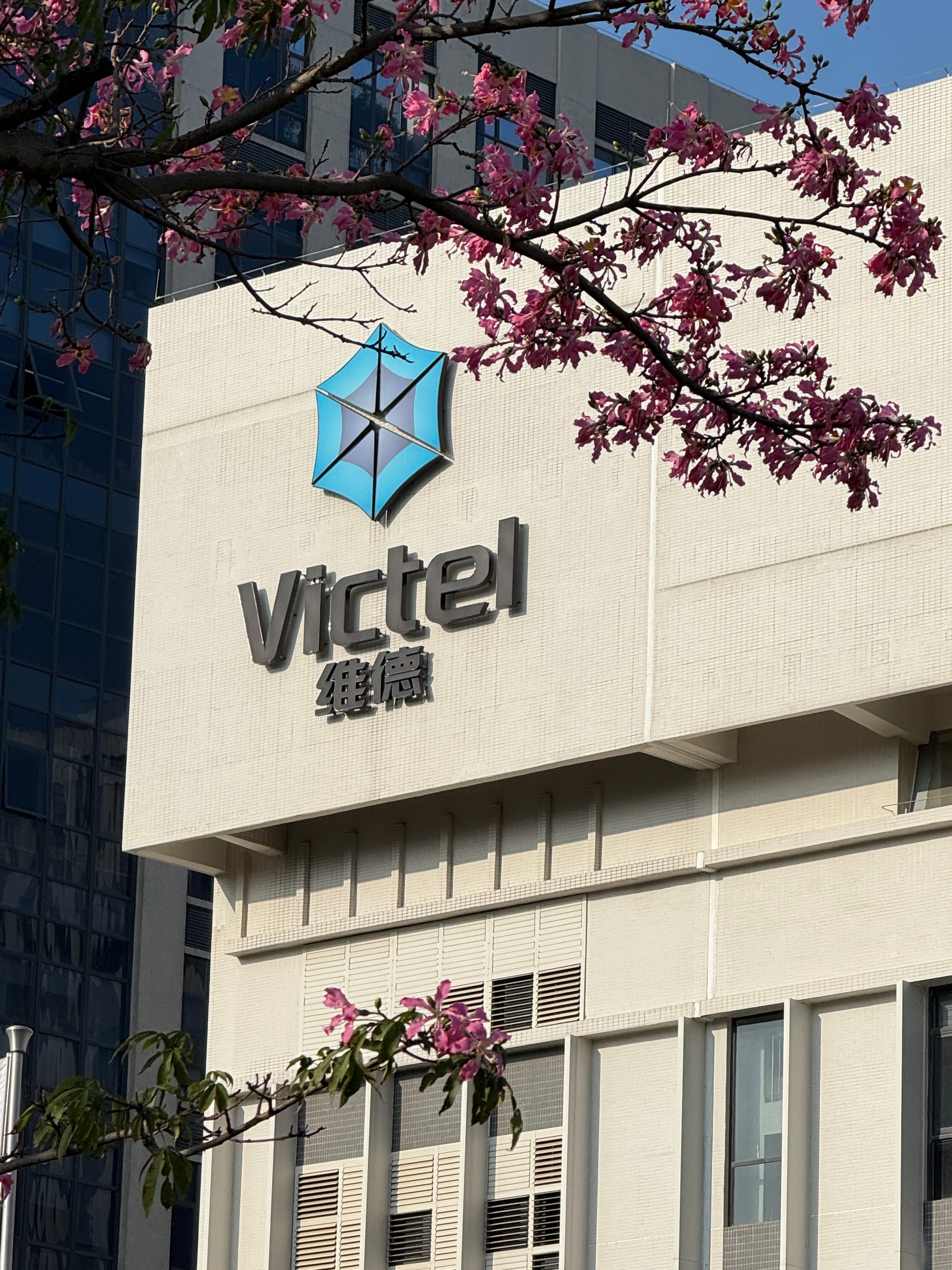
Guangzhou Victel Technology Co., Ltd (广州维德科技)
When Everything Fails: The Problem PMR Never Solved
— and One Chinese Company’s 15-Year Answer
There is a question that everyone in the professional mobile radio industry knows the answer to, but rarely says out loud.
What happens to your TETRA network when the fibre backhaul is cut? What happens to your P25 system when the base stations lose power? What happens to your DMR trunking when the controller goes down? The honest answer, in every case, is the same: it degrades, fragments, or fails. The standards that define professional mobile radio — every major one, without exception — were designed around the assumption that some form of infrastructure will be available. Remove that assumption, and the architecture unravels.
For most deployments, most of the time, this is an acceptable trade-off. Infrastructure is usually available. But in the scenario that matters most — the major earthquake, the catastrophic flood, the large-scale industrial disaster — infrastructure is precisely what disappears first. Roads gone. Power cut. Fibre severed. The “三断” (three-break) scenario, as China’s emergency management community calls it, is not an edge case. It is the condition under which communications are most needed and most likely to fail.
This is the problem that Tsui Kinghoi decided to solve. It took him fifteen years.
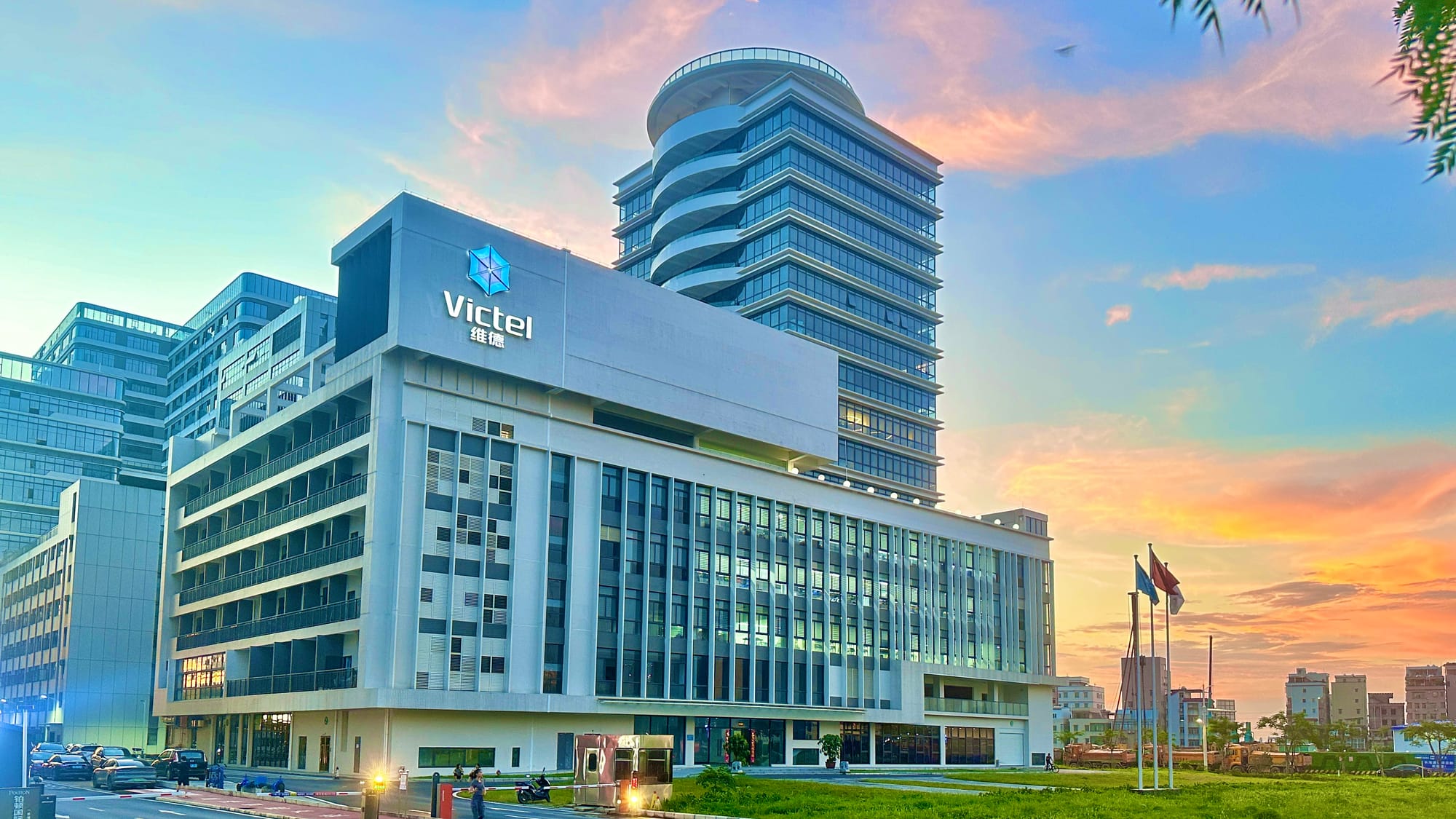
Victel headquarters,Guangzhou
The Answer the Industry Wasn’t Building
In 2023, Guangzhou Victel Technology — a company that has worked in the UHF narrowband communications space for 28 years — released a Narrowband Trunking Mesh Network system with fully independent intellectual property. The architecture it is built on has no direct equivalent in the global PMR market.
The core principle is radical in its simplicity: the network forms entirely from the radio links between its own nodes. There is no backhaul. No centralised controller. No dependency on any external infrastructure of any kind. Each node is simultaneously a base station, a relay point, and a self-powered unit — equipped with integrated solar and wind energy options. The network is, by design, indestructible by the failure of any single component, because there is no single component that the rest depends on.
The practical result is a system that behaves differently from anything else in the PMR category in the moments that count:
It deploys in minutes, not hours. Vehicle-mounted, portable, and man-portable nodes self-organise automatically on arrival. A functioning trunking network covering last-mile blind spots — underground spaces, mountain terrain, collapsed urban environments — can be operational before a conventional system has finished its startup sequence.
It heals itself.Dynamic topology self-healing means the network automatically reconfigures around node failures. In a disaster environment where nodes may be damaged, moved, or destroyed, the network adapts rather than collapses.
It does everything a trunking system should do — individual call, group call, broadcast, priority override, remote stun and kill, identity display, location and data return — without requiring the infrastructure those features normally depend on.
It costs significantly less.Construction and maintenance costs run more than 50% below conventional narrowband networks — a figure that matters enormously for the budget-constrained procurement environments that most emergency agencies, in China and globally, actually operate within.
The system has already been tested in China’s most demanding conditions. In May 2025, Victel’s narrowband mesh network served as the primary communications backbone during a major flood disaster response across three affected regions — a large-scale, multi-agency operation conducted in precisely the three-break conditions the technology was designed for. It performed.
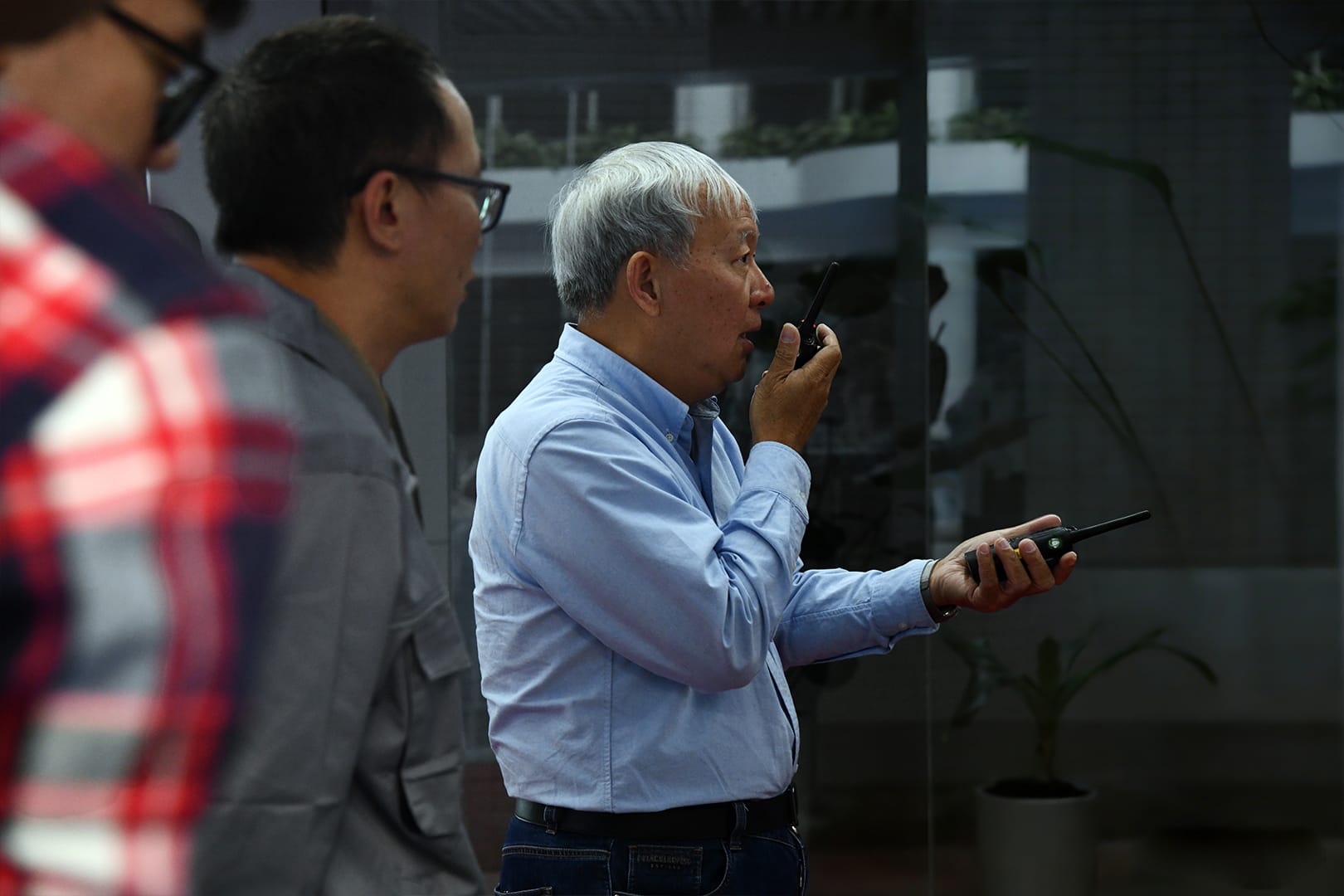
Tsui Kinghoi personally conducted product testing on the Victel terminals for the customer.
Why Only This Kind of Company Could Build It
Fifteen years is a long time to work on a problem the market has not yet asked you to solve.
Most technology companies cannot do it. The quarterly reporting cycle, the investor return expectations, the pressure to show incremental progress against commercial metrics — these forces pull organisations toward problems with near-term payoffs and away from the kind of deep, patient technical work that produces genuinely new answers to genuinely hard problems.
Tsui Kinghoi built Victel to be structurally immune to those forces.
The company operates without department heads, without management titles, without attendance tracking, and without short-term performance metrics. Capital returns are excluded from the profit distribution framework. Xu’s philosophy is explicit: “Talent is equity, innovation is wealth.” The organisation exists not to generate returns for capital, but to serve as what he calls an “ecological community” — a structure that carries employees’ ambitions and values, that treats every person’s knowledge and contribution as the company’s core asset.
The result is an organisation where more than 50% of employees have been with the company for over a decade — and where the institutional will to spend fifteen years in what Victel calls “technology no-man’s land” was not just possible, but natural. You cannot mandate that kind of patience through management. You can only create the conditions for it.
Leadership at Victel does not come from titles. It emerges from competence — the person who understands the problem most deeply leads the technical decision; the person closest to the customer leads the commercial judgment. There are no organisational layers to navigate and no political capital to accumulate. The company has operated this way for 28 years. It works.

Tsui Kinghoi speaks to the Victel team
“Another PMR” — and What That Really Means
When Tsui Kinghoi describes Victel to international audiences, he uses a phrase that is easy to mishear: “another PMR system.”
He does not mean another competitor in the existing PMR market. He means a different answer to a different question — a system that does not compete with TETRA or P25 or DMR on their own terms, but addresses the scenario that none of them were designed for.
For the global critical communications industry, that framing is worth sitting with. The deployment environments where communications matter most — remote, disaster-affected, infrastructure-poor — are also the environments where every major PMR standard carries its deepest structural vulnerability. Victel’s narrowband mesh architecture was built specifically for those environments, by a company that spent fifteen years doing the work nobody else was willing to do.
Tsui Kinghoi has never attended a trade show. He does not do exhibitions, networking dinners, or industry conferences. He stays in Guangzhou and works on the technology.
Which makes it all the more significant that Victel has started appearing on the global stage — at PMRExpo 2023 in Cologne, at CCW Dubai 2024. The company is moving outward. The founder stays put, which, if you understand how Victel works, makes perfect sense: the organisation does not need him in the room to represent it. It already knows what it is doing.
Most of the global critical communications industry has not yet heard of Victel. That is unlikely to remain the case for long.
Victel (广州维德科技有限公司) is headquartered in Guangzhou, China, and has been operating in the UHF narrowband communications sector for 29 years.
www.victel.cn