What Overseas Buyers Should Know About Sourcing Radios from China
A practical guide to the QUANZHOU-Shenzhen supply base-structure, certification, and the questions that matter
Share ↓
If you distribute, specify or procure professional radios outside China, you are almost certainly already buying from one Chinese industrial cluster — whether or not the name appears anywhere on the product.
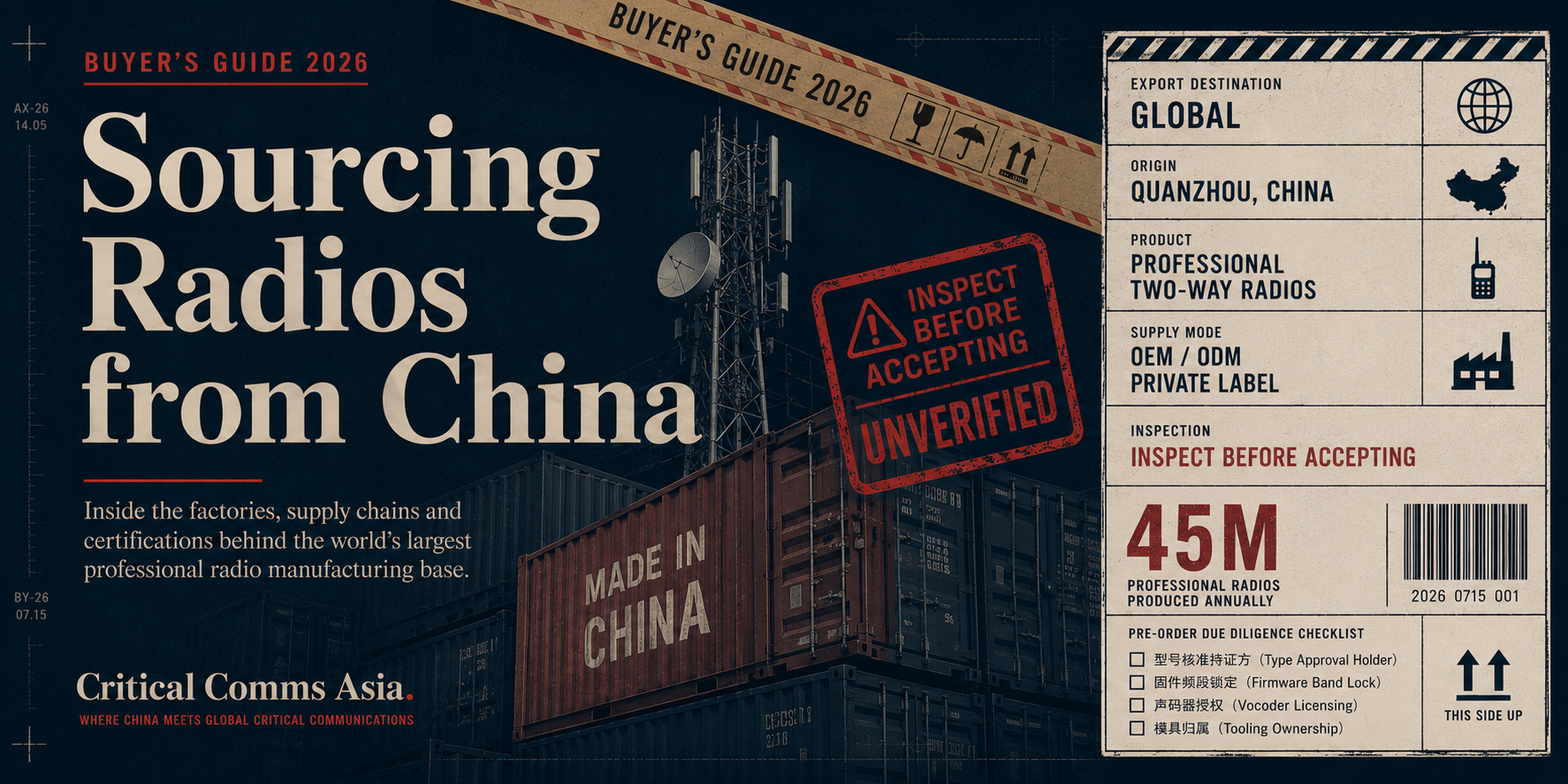
Quanzhou, in Fujian province, produces more than 45 million radios a year. That is roughly 70% of China’s total output and more than half of global production, according to the Quanzhou Radio Regulatory Bureau. The industry is concentrated in Nan’an, particularly Xiamei (霞美镇)township, with around 80% of components sourced locally.
Most international buyers deal with this cluster indirectly — through a brand, a trading company, or a Shenzhen sales office. That works until it doesn’t. What follows is what the structure actually looks like, and what to ask.
1. The supply base is wider than two cities
Quanzhou is where manufacturing scale is concentrated, and Shenzhen is where most of the system and standards vendors are based. But it would be a mistake to treat those two cities as the whole map.
Radio and private network equipment manufacturers are also scattered across Beijing, Shanghai, Chengdu, Guangzhou and Chongqing. These are generally not volume producers. In Chengdu and Chongqing in particular, suppliers tend to come out of a military electronics and defence-industrial background, and are oriented toward industry-specific private networks rather than commercial or consumer product.
For a buyer, the practical point is this: do not infer capability from location. A supplier in a city with no radio cluster may be exactly the specialist you need for a demanding industrial application, and a supplier with a prestigious address may be a trading company. Location tells you about industrial history. It tells you very little about the company in front of you.
2. Know which layer you are talking to
Chinese PMR suppliers fall into broadly distinguishable layers, and the distinction matters more than any product datasheet.
System and standards vendors. Companies with their own R&D, standards participation, and system integration capability — trunking infrastructure, dispatch platforms, encryption, public-safety deployments. These firms typically hold their own type approvals, own their firmware stack, and can support a network, not just ship terminals.
Own-brand manufacturers with in-house production. SMT lines, tooling, injection moulding and assembly under one roof. They sell their own brand and take OEM/ODM work alongside it. This is the largest tier by volume.
Trading companies and brand offices. No production. They source from the above and add commercial functions. Not inherently a problem — many are competent, and some add real value in certification and export handling — but you should know when you are dealing with one, because it changes who is accountable when there is a quality issue.
The practical test: ask for the address of the production facility, the tax registration entity, and the name on the type approval certificate. If all three are the same, you are dealing with a manufacturer. If they diverge, ask why. There are legitimate answers — R&D in Shenzhen, production in Quanzhou is a common and entirely normal structure — but you should hear the answer rather than assume it.
3. Understand why so many radios look alike
A structural feature of this cluster that surprises buyers: a large share of Chinese-made radios are built around a small number of domestic PMR system-on-chip platforms.
This is why competing products from different suppliers can share near-identical RF performance, menu structures and audio characteristics. It is also why a supplier’s claimed “in-house development” may mean industrial design and firmware customisation rather than baseband development.
The implication for buyers is direct. If you are commissioning an ODM product and expecting differentiation, establish early what is actually being customised: housing and industrial design, firmware and UI, RF front-end tuning, or the underlying platform. These are very different levels of investment, and they carry very different lead times and tooling costs.
4. Certification: what to verify, not what to accept
CE, FCC, RoHS and UKCA marks are near-universal claims across this supplier base. Higher-tier certifications — ATEX or IECEx for explosion-proof, IP67/68, MIL-STD-810 — are held by a smaller number of firms.
Three things to check rather than assume:
Certificate holder identity. Confirm the certificate is issued to the entity you are contracting with, for the model you are buying. Certificates issued to a related company, or covering a similar-but-not-identical model, are a recurring source of problems at customs and in the field.
Test report, not just the certificate. Ask for the full report from the notified or recognised body. Compare the tested configuration against what you are actually ordering.
Ongoing compliance for the market you sell into. This deserves emphasis. Chinese-manufactured amateur and commercial radios have a documented history of enforcement issues in the United States and elsewhere over out-of-band transmission capability and marketing of non-certified equipment. If you are selling into a regulated market, the compliance burden lands on the importer and distributor, not the factory. Verify the frequency lockout behaviour of the actual firmware build you are receiving.
5. China’s own type approval regime is a useful signal
China operates a model type approval system for radio equipment, and its recent evolution is informative for foreign buyers.
Under MIIT’s Document 666 (issued December 2009), type approval for 150MHz and 400MHz analogue radios stopped being issued from January 2011, with a transition period that ultimately ran to the end of 2017.
For a buyer, the useful point is that type approval status is a matter of public record, issued by a body with no commercial interest in the outcome. A supplier’s approval history tells you whether its regulatory and technical documentation function actually works — which is a reasonable proxy for whether the rest of its documentation will hold up. Ask for the certificate, and check the holder and model against what you are buying.
6. Be realistic about what this cluster is — and is not
Fujian’s provincial industry authority has stated publicly that Quanzhou’s radio products sit largely at the low-to-mid tier of the industry, with disorderly low-price competition working against upgrading. A research study by Xiamen University’s technology and innovation support centre reached a similar conclusion about the cluster’s position on talent, technology and products.
These assessments are worth reading carefully, and worth reading for what they actually measure. Both are judgements about the cluster in aggregate, against a policy benchmark of industrial upgrading. Neither is a statement about any individual company, and neither measures competitiveness in the market a buyer actually operates in. A cluster can sit at the low-to-mid tier on average while containing firms that compete internationally on capability — and Quanzhou does.
That distinction matters commercially. Alongside the several hundred small assembly operations, the cluster contains established manufacturers with genuine digital development capability — DMR, dPMR, PoC, multi-mode, explosion-proof and trunking products, full certification portfolios, and in several cases decades of continuous R&D. Some of these firms hold their own type approvals, participate in domestic standards work, and supply industrial and public-safety customers. Price-performance at this tier is, by a considerable margin, the strongest available anywhere.
What the official assessments do capture accurately is the shape of the distribution. The cluster’s aggregate output is still weighted toward analogue and low-cost product, which is what produces the price competition the provincial authority describes. The strong firms exist within that distribution, not as a substitute for it.
The practical implication for a buyer is not “avoid Quanzhou.” It is that the range between the best and the weakest supplier here is unusually wide, and that the cluster’s reputation — in both directions — will tell you nothing reliable about the specific company you are dealing with. Identify the tier, then verify the firm.
For commercial, hospitality, construction, logistics and general enterprise deployment, this supply base is highly competitive and improving quickly on digital capability. For mission-critical infrastructure — nationwide trunking, government security certification, long-cycle support commitments — the set of qualified suppliers is smaller, and includes both Quanzhou firms operating at the upper end and the system vendors based in Shenzhen.
7. A short due diligence list
Before placing a first order with a new Chinese supplier:
- Production facility address, and whether you can visit it
- Tax registration entity versus the entity on your contract
- Type approval certificate holder and model number match
- Full test reports for the markets you sell into
- Firmware build version and frequency lockout behaviour
- Whether the chipset platform is licensed and what IP is included
- After-sales terms: spares availability window, firmware update commitment, RMA process
- Codec and protocol licensing — confirm who holds the licence for the vocoder and any proprietary digital protocol
- MOQ, tooling cost ownership, and what happens to tooling if you switch supplier
None of this is unusual for industrial sourcing anywhere. It is simply that this cluster is large and highly fragmented, and the range between the strongest and the weakest supplier in it is wider than buyers typically expect. The checklist is how you find out which one you are dealing with.
Critical Comms Asia covers the professional mobile radio and critical communications industry from an Asia-Pacific perspective.