From Standards to Certification: What the GCF–MSSA Agreement Means for 3GPP NTN
Satellite direct-to-device is moving from a standards topic to a certification and interoperability problem. For critical communications, that may matter more than the satellites themselves.
Share ↓
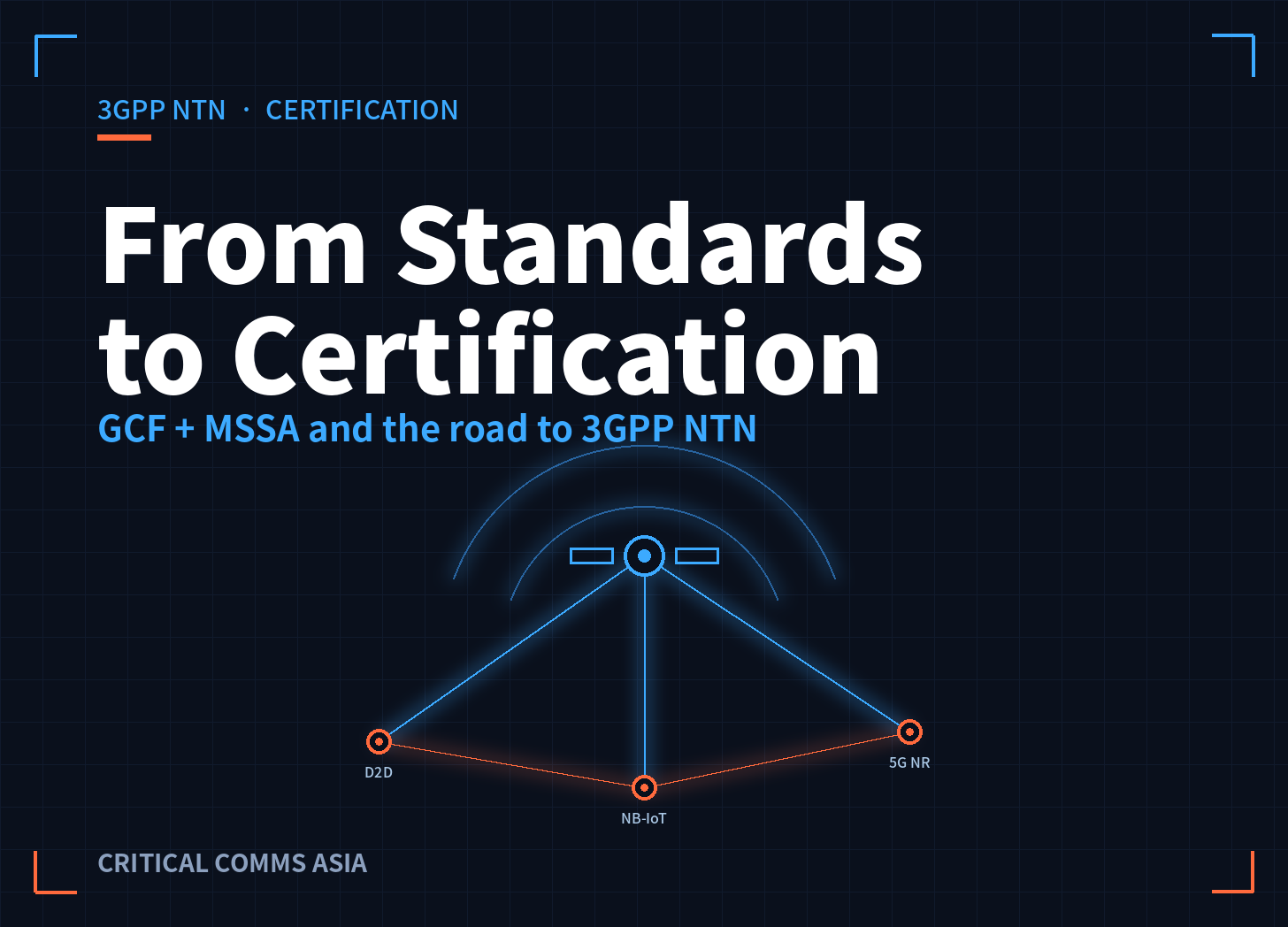
On 24 September, the Global Certification Forum (GCF) and the Mobile Satellite Services Association (MSSA) signed a memorandum of understanding to work together on certification requirements and test frameworks for 3GPP Non-Terrestrial Networks (NTN). The scope covers NTN 5G NR, NTN NB-IoT and direct-to-device (D2D) services.
The agreement is not the start of NTN industrialization. It is the latest step in a chain that began with the standards.
2022: NTN enters the 3GPP specifications
Release 17 was the first 3GPP release to include NTN specifications: NR-NTN for satellite broadband, plus NB-IoT and eMTC support for low-power devices. Functional freeze came in March 2022, and ASN.1 freeze in June.
The idea behind it was simple. Traditional satellite communications relied on dedicated terminals and closed systems. 3GPP NTN uses standardized cellular technology so a device can connect to a satellite much as it connects to a tower, making the satellite an extension of the mobile network.
2024: certification begins, partially
Standards define how devices communicate. Certification tests whether different vendors' devices actually work together.
According to GCF, conformance testing for NTN NB-IoT over GEO satellite systems has been available in its certification scheme since 2024. Extending this to LEO constellations and to NTN 5G NR is still in progress. In other words, certification today covers only part of what NTN is expected to deliver.
2026: capabilities keep expanding
There are now two routes to direct-to-device connectivity. One uses existing LTE or 5G technology so that unmodified phones can connect. The other uses the dedicated NTN standards, with broadband and IoT service in satellite spectrum.
On the 3GPP side, Release 18 improved coverage for handheld devices, studied deployment above 10 GHz, and addressed mobility and service continuity between terrestrial networks and NTN. Release 19 added downlink coverage enhancements, higher uplink capacity, regenerative payload support and RedCap devices for NR NTN.
The regenerative payload is worth watching. Releases 17 and 18 assumed a transparent payload, where the satellite relays signals. A regenerative payload gives the satellite onboard processing, so it becomes network infrastructure rather than a relay in the sky.
24 September: the focus shifts to interoperability
The GCF–MSSA agreement also aims to advance interoperability between terrestrial and non-terrestrial networks, and between different satellite constellations. MSSA member operators will provide live networks for validation and field testing.
The industry chain is becoming clearer:
3GPP standards → chipsets and devices → GCF certification → network interoperability → terrestrial/satellite integration → commercial deployment
Why critical communications should pay attention
Earthquakes, floods and wildfires can damage base stations, fiber and power at the same time. A device that can reach a satellite gives responders another way to connect where terrestrial coverage is absent or destroyed.
This does not mean NTN will replace LMR, private LTE/5G or MCX. It more likely adds an aerial access layer to a critical communications architecture that could include:
Narrowband networks such as DMR and TETRABroadband LTE/5G with MCXSidelink and ad hoc networksNTN satellite connectivity
In that picture, NTN mainly addresses coverage and infrastructure resilience.
The open question
The contest is no longer just about who can connect a phone to a satellite. The harder problem is whether devices from different vendors, different constellations and ground-based private networks can work together at a disaster site.
Certification and interoperability testing look like the first real test. Who will run that test for mission-critical users, and when?