Location Just Became Part of MCPTT's Signaling
Here's Why That's a Bigger Deal Than It Sounds
Share ↓
A newly granted U.S. patent from Samsung Electronics covers something narrow on paper: sharing a user's location during a "remote ambient listening" call in MCPTT, the 3GPP mission-critical push-to-talk standard. Read the claim on its own and it looks like a minor feature update. Read it alongside the standards trail behind it, and it looks more like a preview of where mission-critical communications is heading — and who's shaping the route.
What ambient listening actually does
Remote ambient listening is not a new idea. Within MCPTT, it lets an authorized dispatcher listen in on the audio environment around a first responder's device — without that responder having to do anything. It's built for exactly the situations where you'd expect it: policing, firefighting, emergency response, any scenario where a dispatcher needs a sense of what's happening around someone in the field.
The gap is that hearing the environment and knowing where it is are two different problems. MCPTT already supports location sharing as a general capability, but wiring it specifically into the remote ambient listening flow — in a standardized, interoperable way — isn't as simple as "just turn on GPS." It's a signaling problem.
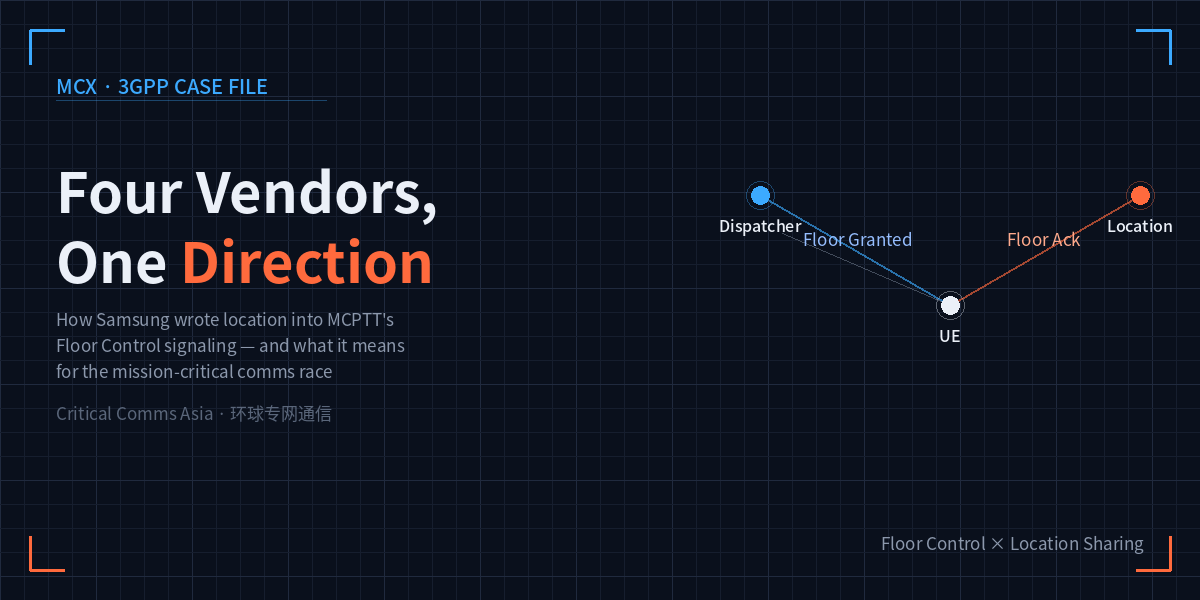
That's the specific gap Samsung's patent addresses. The method it describes doesn't stand up a new location channel. It rides on Floor Control — the mechanism that governs who has permission to talk in a PTT system, expressed through messages like Floor Grant, Floor Request, Floor Taken, and Floor Ack.
The mechanism, in short: when a dispatcher initiates a remote ambient listening call, the server sends a Floor Granted message that requires acknowledgment. The target device responds automatically — no button press required — with a Floor Ack. If the user's MCPTT profile permits it, that Floor Ack carries the device's location alongside the floor confirmation. The server then passes that location to the monitoring party.
Per the underlying 3GPP procedure (TS 24.380), when a Floor Granted message requires acknowledgment, the call originated as a remote ambient listening call, and the user's configuration permits location sharing, the device includes location in the Floor Ack; where the configuration doesn't permit it, the device omits location or marks it as not provided.
The elegance here isn't in solving "how do we locate someone." It's in making location a native field inside signaling that every compliant device already implements — rather than bolting on a separate positioning layer.
A patent that traces back to a standards proposal
The more interesting part of this story predates the patent by several years. Around 2020, Samsung brought a change request to 3GPP against TS 24.380 covering talker location sharing in remote ambient calls, along with related corrections to location-sharing behavior during call setup and current-talker location in ambient calls — all attributed to Samsung in the public change-request record.
(A note on sourcing: the specific CR numbers and their approval status referenced in earlier drafts of this reporting come from prior research and have not been independently re-verified against 3GPP's live portal for this piece. Treat exact CR identifiers as provisional pending confirmation.)
If that sequence holds, the order of events is worth sitting with: Samsung didn't file a patent and then get lucky when 3GPP happened to adopt something similar. It was working the standards process directly — proposing the mechanism, getting it debated and refined through 3GPP's working groups — and the patent followed as a natural downstream step. Product need, standards proposal, protocol change, product capability, patent. In that order.
Four vendors, one direction
Samsung is not alone in pushing toward richer situational awareness in mission-critical networks. Motorola Solutions has long built ambient monitoring into its critical communications portfolio. Hytera's MCS platform folds ambient listening into its broadband mission-critical stack. Nokia's public safety solutions treat positioning, video, and sensor data as components of one operational picture rather than separate features.
The direction — connect, then locate, then sense — is shared across the industry. What differs is the mechanism each vendor uses to get there.
A proprietary feature lives inside one vendor's product roadmap. It can be fast to ship and easy to differentiate on, but it stays that vendor's feature — interoperability is optional, and competitors aren't obligated to follow.
A capability written into the standard itself is a different kind of asset. Once location-sharing sits inside Floor Control — a mechanism every MCPTT-compliant device has to implement to be MCPTT-compliant at all — it stops being a Samsung feature and becomes infrastructure the whole ecosystem eventually has to support, regardless of who originated it. That's a slower path to market, but it's a harder one to compete against later.
The bigger pattern: from communication to comprehension
Zoom out, and this fits a pattern visible across MCX's evolution more broadly. Release 13 introduced MCPTT itself. Release 14 added MCData. Release 15 brought MCVideo. 5G-era work integrated MCX with the 5G system core. And now, location is quietly migrating from "a feature dispatchers can request" to "a field inside the signaling that carries every call."
The practical effect: a dispatcher's question is shifting from “can I reach you” to “can I reach you, do I know where you are, and do I understand what's happening around you.”That third piece — ambient awareness — is what starts to look like real-time situational awareness rather than communication in the traditional sense.
None of this changes MCPTT's fundamentals overnight. But it's a useful data point for anyone tracking where mission-critical standards work is actually headed: not toward faster push-to-talk, but toward networks that give command centers a clearer, faster read on what's happening in the field — with location, audio, video, and eventually AI-driven analysis converging inside the same standardized signaling layer.
That convergence — not any single patent claim — is probably the real story here.