China Just Wrote “Low-Altitude Economy” Into National Law. Here’s What That Actually Means for Networks.
On July 1, 2026, a quiet but significant change took effect in Chinese aviation policy.
Share ↓
On July 1, 2026, a quiet but significant change took effect in Chinese aviation policy. The country’s Civil Aviation Law — the foundational statute governing everything from airworthiness certification to passenger rights, first enacted in 1995 — was revised for the seventh time, and for the first time, it now contains an explicit legal mandate for something called the “low-altitude economy.”
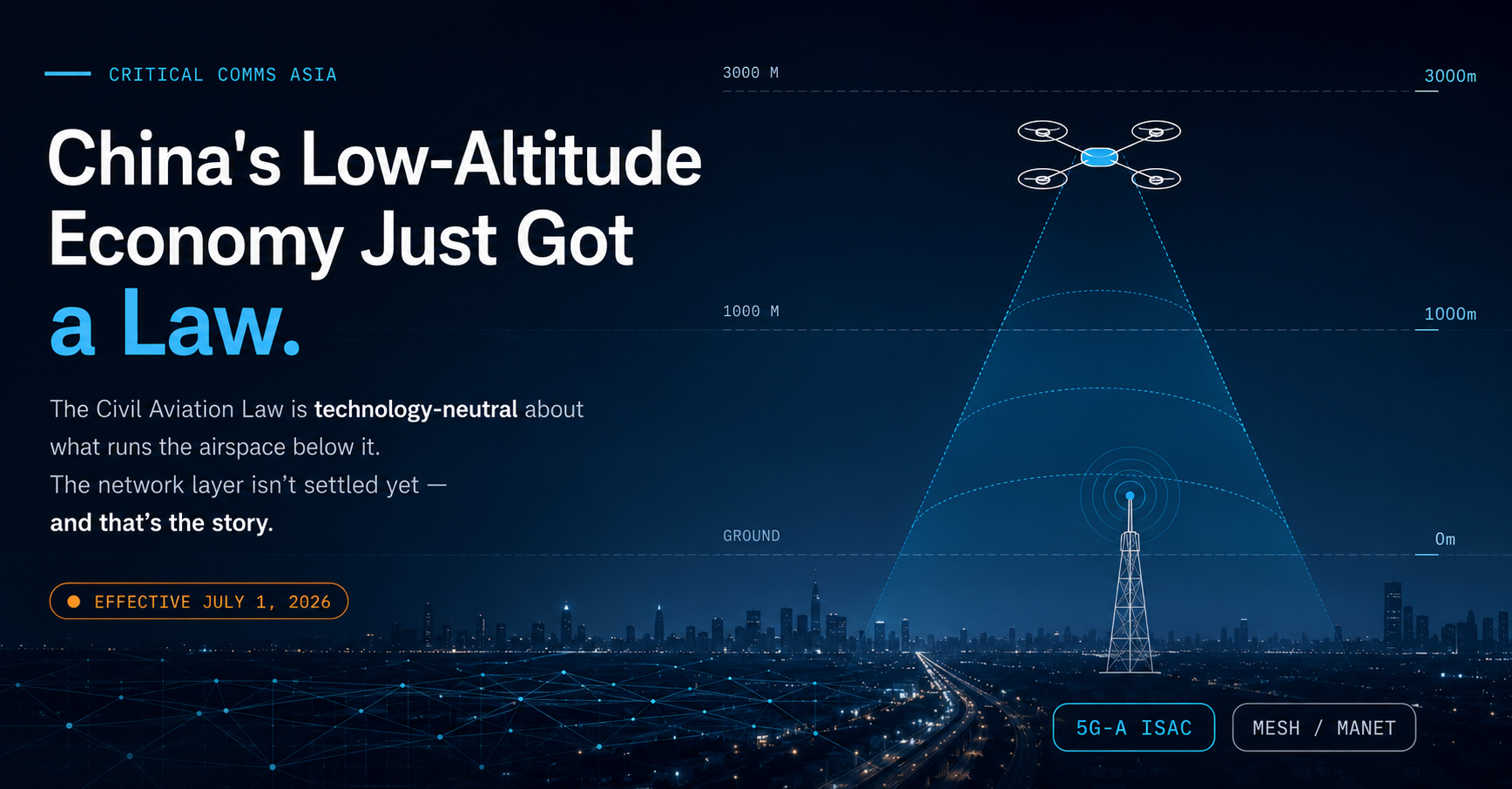
If you follow UAS Traffic Management (UTM) or Advanced Air Mobility (AAM) in the US or Europe, this will sound familiar. It’s the same underlying conversation — but the Chinese framing is broader. AAM and UTM in Western regulatory language tend to center on passenger mobility: air taxis, eVTOL, urban air mobility. China’s “low-altitude economy” is a wider basket: logistics, agricultural inspection, emergency response, tourism, industrial monitoring — essentially every commercial activity happening below 3,000 meters, with traffic management as the connective layer underneath all of it. There isn’t a single Western term that maps cleanly onto the full scope of what Beijing means by the phrase, which is part of why “low-altitude economy” itself has started showing up untranslated in English-language industry writing.
The provision that matters
Article 225 of the revised law is short and, on its face, unremarkable. It commits the state to optimizing low-altitude airspace resource allocation and to building a national regulatory service platform for low-altitude flight and applications. It also directs regulators to establish airworthiness certification and flight management standards suited to the sector’s needs.
What’s notable is what the article doesn’t do: it doesn’t specify a network architecture. It creates a legal obligation for a monitoring platform to exist, and leaves the technical question of what runs underneath that platform completely open. That’s not an oversight — Chinese industrial policy has historically preferred to set outcomes and let competing technical approaches sort themselves out at the pilot-city level before consolidating around a standard. And in this case, two distinct technical lineages are already competing for that space.
Two networks, one airspace
The first is carrier-led. China Mobile, China Telecom, and China Unicom have all run live 5G-Advanced Integrated Sensing and Communication (ISAC) trials aimed squarely at low-altitude use cases. In Jiaxing, China Telecom worked with local police on drone flight-path tracking; in Shenzhen’s Futian district, the same technology has been used for geofencing and precision trajectory tracking; in Shantou, a 5G-A sensing base station has been deployed to build an electronic fence around an offshore wind farm and track vessel movement in real time. China Mobile has run a parallel “trusted drone access” trial in Sichuan, explicitly marketed around the idea that cellular-network-based drone connectivity is inherently more “manageable and controllable” — a direct appeal to what regulators actually want from a monitoring platform: identity that’s tied to a SIM, and a network-side record of where a device has been.
The second lineage is infrastructure-independent: mesh or self-organizing networks (MANET) that don’t depend on cellular coverage at all. Their value proposition is close to the inverse of the carrier approach — they matter most exactly where carrier infrastructure doesn’t reach, or where it’s failed: disaster zones, remote terrain, search-and-rescue operations, firefighting.
Neither approach has been formally endorsed by the new law. What the law has done is create the demand signal and let the market answer it in the field, one pilot city at a time.
A market test that already happened
The mesh/MANET side of this story has a data point that’s easy to overlook if you’re only reading Chinese-language coverage: it already has a real capital-markets validation, and it happened in the United States.
In May 2025, Motorola Solutions — the largest public-safety communications company in the world — announced its acquisition of Silvus Technologies, a US-based MANET communications company, for up to $5 billion (a reported $4.4 billion in cash plus up to $600 million in earnout). The deal closed that August. Silvus’s core technology is software-defined, high-mobility mesh networking that explicitly does not require fixed infrastructure — the same fundamental proposition as the mesh-network vendors positioning themselves around China’s low-altitude economy build-out. Motorola Solutions’ own stated rationale for the deal was the growing safety, security, and defense demand tied to autonomous systems.
That’s a useful anchor point for anyone trying to gauge whether mesh/MANET is a durable technology category or a stopgap that carrier networks will eventually absorb. A $5 billion acquisition by the industry’s largest public-safety player is a fairly unambiguous signal that infrastructure-independent networking has standalone commercial value — not just as a niche complement to cellular coverage, but as a category serious enough to be worth building a platform around.
None of this means Chinese mesh-network vendors will command similar valuations, or that the Silvus deal maps neatly onto China’s regulatory environment — the customer base, the defense-versus-civilian mix, and the exit landscape are all different. But it does mean the underlying technical bet — that infrastructure independence is worth paying for — has already been tested once, in public, at scale.
What to watch next
China’s new Civil Aviation Law has done the easy part: it has created a legal container for the low-altitude economy and mandated that a regulatory platform be built. The harder part — deciding what network layer that platform actually runs on — is still being contested, pilot city by pilot city, between carrier-based ISAC and infrastructure-independent mesh. Whoever wins that contest, or however the two approaches end up coexisting by use case, will shape not just China’s low-altitude economy but the export playbook Chinese communications vendors eventually take to other countries writing their own version of this law.