China’s “Six Networks” Bet: What a Beijing Press Briefing Reveals About Competing Models of Digital Infrastructure
On July 20, China’s State Council Information Office held a routine mid-year briefing on the telecom sector’s performance.
Share ↓
On July 20, China’s State Council Information Office held a routine mid-year briefing on the telecom sector’s performance. On paper, it was the kind of event that produces a wall of statistics and little else: 5.102 million 5G base stations, 32.86 million gigabit-capable ports, 2,185 EFLOPS of intelligent computing capacity, up 177% year-on-year. The kind of numbers that are impressive in aggregate and largely uninterpretable outside China’s own planning cycle.
But buried inside the briefing were two things that matter well beyond China’s borders: a spectrum decision with direct relevance to the global 6G standardization race, and a governance concept — the “six networks” (六张网) — that says something interesting about how China intends to treat telecom infrastructure differently from how Western markets have treated it.
The Spectrum Signal: 6GHz and the Standards Race
Xie Cun, spokesperson for the Ministry of Industry and Information Technology (MIIT) and director of its Information and Communication Administration, confirmed at the briefing that MIIT has approved trial-use licenses for 6G experimentation in the 6GHz band, and that the second phase of China’s 6G technology trials is being accelerated. This is a follow-through on an approval MIIT first granted in May 2026 to the IMT-2030 (6G) Promotion Group, the country’s main 6G coordination body, authorizing field trials in the 6,425–7,125 MHz range — what industry participants have taken to calling the “golden spectrum” for its balance of coverage, capacity, and latency characteristics.
Why this matters internationally has less to do with China’s domestic rollout timeline and more to do with the fact that spectrum allocation is one of the few genuinely global bottlenecks in mobile technology. The 6GHz band has been a contested resource for years. The U.S. Federal Communications Commission opened the full upper 6GHz band for unlicensed Wi-Fi use back in 2020, leaving no mid-band spectrum explicitly reserved for cellular 6G. Europe has been slower still, continuing to debate how to split the band between Wi-Fi and mobile use rather than committing to one path. China, by contrast, first allocated 6GHz for 5G and 6G use in 2023 and has now moved to authorized field trials — a regulatory sequencing that puts it ahead of most peer markets in translating spectrum policy into usable test infrastructure.
This has direct implications for the private and critical communications sector specifically. Any 6G-era mission-critical services — the kind of ISAC (integrated sensing and communication), AI-native, and resilience-focused capabilities described in 3GPP’s TR 22.870 use case study — will need mid-band spectrum with the propagation and capacity characteristics that 6GHz offers. Whoever controls trial outcomes ahead of the ITU’s 2028 submission window for 6G standards is better positioned to shape which technical solutions become essential patents. China is estimated to hold a substantial share of global 6G patent filings, and structured, government-coordinated field trials are a direct lever for consolidating that position before international standardization work closes.
For operators, vendors, and integrators in the critical communications space outside China, the practical takeaway isn’t “commercial 6G is coming” — that remains years away by every account, including China’s own three-phase trial roadmap. It’s that the technical solutions likely to be proposed into 3GPP and ITU standardization processes are increasingly being pre-validated in Chinese field trials first, under domestic performance frameworks, before they reach the international table.
The Governance Signal: What “Six Networks” Actually Proposes
The second, less spectrum-specific but arguably more structurally interesting element of the briefing was Xie’s description of what China calls its “new-generation communication network” (新一代通信网), situated within a broader “six networks” framework that Chinese central authorities designated as a planning priority earlier this year.
Xie laid out four defining characteristics of this new-generation network: connectivity expanding from human users to machines, objects, and embodied AI systems; coverage extending beyond terrestrial limits toward integrated space-air-ground-sea coverage; connection capability delivering the kind of deterministic, stable performance that differentiated industrial applications require; and network functionality evolving from pure data transmission toward a fusion of communication, sensing, computing, intelligence, and security.
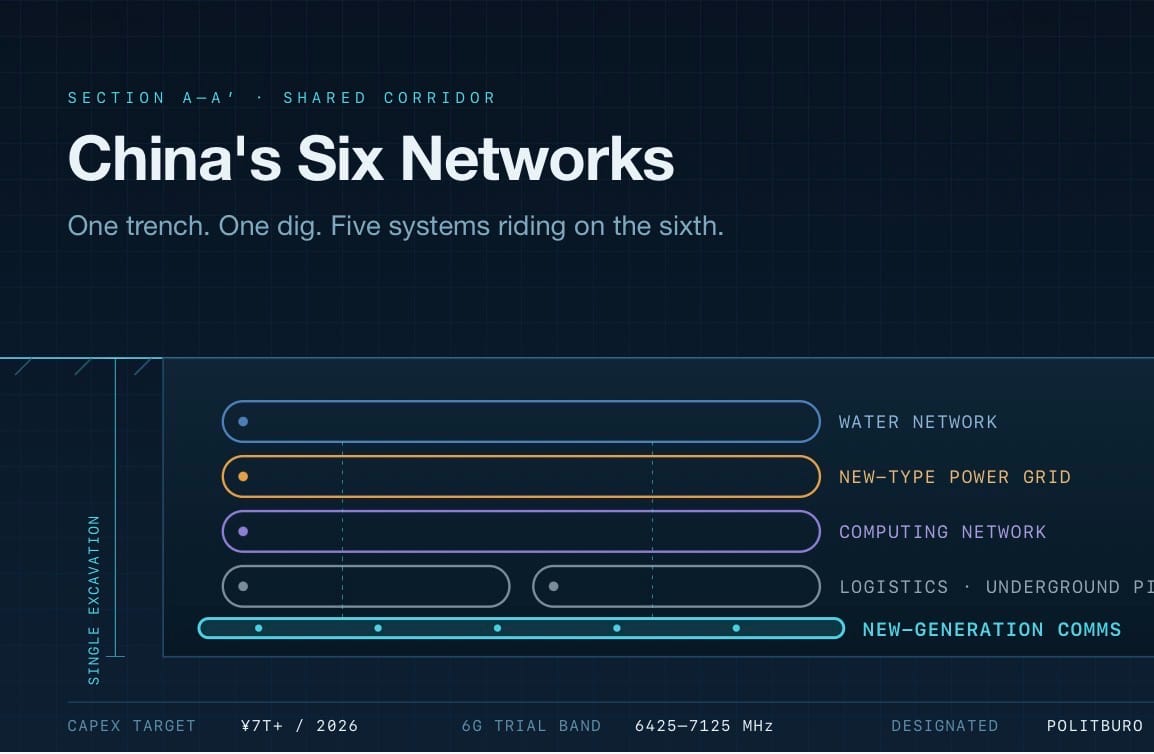
Taken alone, this reads as a fairly standard 6G vision statement — one that echoes much of what’s already been published in 3GPP’s own 6G use case studies. What makes it worth international attention is the explicit tie to the “six networks” concept, under which the communication network is designated not as a standalone infrastructure category but as a shared substrate meant to enable synergistic innovation across five other infrastructure systems: the water network, the new-type power grid, the computing network, urban underground pipeline networks, and the logistics network.
This isn’t just aspirational language. The “six networks” designation traces back to a Politburo meeting on April 28, 2026, and China’s top economic planner, the National Development and Reform Commission, has since put a number on it: related investment across these six domains is projected to exceed RMB 7 trillion (roughly $980 billion) this year alone. The funding structure that’s been disclosed breaks down into RMB 755 billion in central budgetary investment, RMB 800 billion in ultra-long-term special treasury bonds, RMB 800 billion in new policy-based financial instruments, and RMB 4.4 trillion in local government special-purpose bonds — with private capital participation encouraged on top of that base.
More concretely still, the coordination mechanism being proposed isn’t abstract either. Planning documents describe co-construction practices like “multiple poles into one, multiple ducts into one, shared corridors” — meaning telecom fiber deployment and power cable undergrounding are meant to happen in the same physical dig, at the same time, rather than as separate uncoordinated projects. On the data side, the stated goal is for water-network sensor data to flow through the communication network into the computing network for unified, real-time dispatch — a specific technical pipeline, not just a slogan about “synergy.”
This is a materially different framing from how most Western markets conceive of telecom infrastructure investment. In liberalized markets, network buildout is typically driven by operator capital allocation decisions, spectrum auctions, and — where industrial connectivity is concerned — case-by-case private network deployments negotiated between vendors and enterprise customers. China’s model treats physical co-construction and cross-network data flow as matters of central planning and dedicated financing instruments, not market discovery. Whether that produces faster or more coherent industrial connectivity outcomes, or simply more centrally coordinated ones, is an open empirical question — but the financing structure and the engineering coordination mechanism are concrete enough now to track as a distinct model, not just rhetoric.
What to Watch
Two threads are worth following from here. First, whether China’s 6GHz trial results feed into 3GPP Release 20 work in ways that shape mid-band 6G specifications before other markets have finalized their own spectrum positions. Second, whether the “six networks” financing — that RMB 7 trillion-plus figure — actually materializes into named, auditable cross-infrastructure projects (a specific city’s shared-corridor rollout, a specific water-sensing-to-computing-network pipeline) rather than remaining a macro investment target.
Until then, the more useful question for international readers isn’t whether China’s 6G ambitions are credible. It’s whether the financing and engineering-coordination model on display here — treasury bonds and special-purpose bonds earmarked specifically for cross-infrastructure co-construction — becomes a template other governments consider, or remains a China-specific approach shaped by its particular mix of centralized planning and state-owned carrier structure.
What do you think — is state-coordinated cross-infrastructure planning a model other markets will end up converging toward, or is it a structural feature unique to how China builds infrastructure?